I wrote about balance in my last post and what I neglected to write about is why…
Up until five years ago I didn’t feel like I had much ‘balance’ in my life. It’s the main reason I left the corporate world to set up POINT3 Wellbeing in 2018.
The opposite of balance for me is burnout and that’s the point I’d reached. I was burnt out. Fed up. Disconnected.
Don’t get me wrong, for most of my career I enjoyed diverse and interesting roles. I worked with incredibly talented people, on some amazing projects and I travelled to all four corners of the world.
But maybe it was hitting my 40s, or maybe it was something else, but I did reach the point where I’d had enough of chasing more responsibility, more recognition, more money, more I don’t know?? Just more of everything. It felt as though that was the only point of what I was doing. Searching for more, and more was never enough. I suppose I felt a bit empty.
Not that I really knew what was going on at the time. Only now that I’ve done some proper reflection, been through the training and now that I talk about burnout in the workplace and ways to avoid it… only now can I recognise that “Oh yes, that was me!”.
[Quick note that I’m still not immune to it now… even though I’m doing a job that I love, and I know all the theory and ways to avoid it. It’s a constant balancing act ;-)]
Whilst I didn’t recognise that I was “burnt out” at the time, what I did know was… I couldn’t continue in the same way any more.
Something had to change. And I had to take responsibility for myself if I was to find a sustainable and healthy way to continue living my life. Living my life more in line with my values and in a way that gives me more meaning and a true sense of purpose. But also in a way that will set me up for a long, healthy and happy life!
I recently spoke on a podcast about my experiences of burnout and that process in itself was very enlightening for me.
The podcast has just been published and can be listened to here if you’re interested.
Some of the key take-outs I shared are as follows:
- Everyone’s experience will be different and it’s a spectrum. I was relatively lucky that I didn’t get severely ill.
- Burnout is the result of chronic stress that builds up over time. And if not careful and managed, it could go on to develop into something more severe impacting your mental and physical health.
- The key symptoms are – according to psychologist Freudenberger who originally coined the syndrome in the 70s – mental and physical exhaustion; depersonalisation and reduced feelings of accomplishment.
- If you’re a manager or business leader one of the simplest ways you can support your people to help them prevent burnout is to create an organisational culture that cares… one of psychological safety where it’s okay for people to share that they are struggling without the fear of being penalised or discriminated against.
If you recognise any of these symptoms in yourself, know that you are not alone!
According to a study of 20,000 workers by Microsoft in 2022, across 11 different countries, 1 in 2 employees said they were burnt out. And another recent study commissioned by LumApps revealed that up to 88% of UK employees experienced at least some level of burnout over the last two years.
The good news is there are things that we can do to help ourselves prevent reaching the point of burnout.
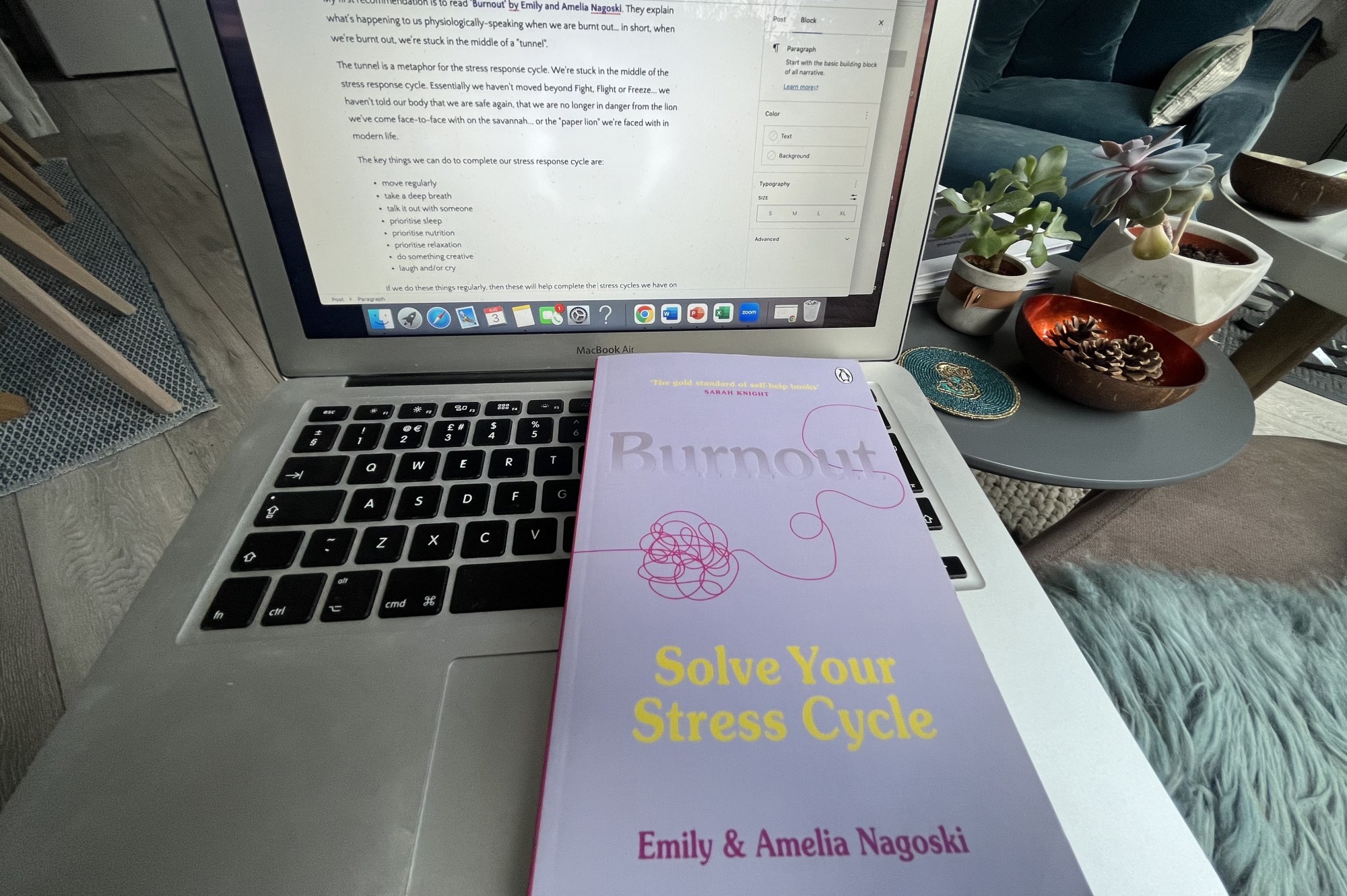
My first recommendation is to read ‘Burnout’ by Emily and Amelia Nagoski. They explain what’s happening to us physiologically-speaking when we are burnt out… in short, when we’re burnt out, we’re stuck in the middle of a “tunnel”.
The tunnel is a metaphor for the stress response cycle. We’re stuck in the middle of the stress response cycle. Essentially we haven’t moved beyond Fight, Flight or Freeze… we haven’t told our body that we are safe again, that we are no longer in danger from the lion we’ve come face-to-face with on the savannah… or the “paper lion” we’re faced with in modern life.
The key things we can do to complete our stress response cycle are:
- move regularly
- take a deep breath
- talk it out with someone
- prioritise sleep
- prioritise nutrition
- prioritise relaxation
- do something creative
- laugh and/or cry
If we do these things regularly, then these will help complete the stress cycles we have on the go. It also means we’re more likely to be able to cope when life gets overwhelming.
So, how do you complete your stress response cycle? Even if you can only commit to 10 minutes a day… do something for you today 🙂
If you’ve found this helpful, do share it with a friend who might benefit and if you think your workplace could benefit from a workshop on burnout, get in touch with me at POINT3 and I can talk through our options.
 Not The Mayo Clinic