Part Three: Doing Differently…
Welcome to part three of my Doubling Down or Doing Differently blog series…
For greater context around this series, I recommend reading part one and part two first.
In short, I’ve been documenting what I’m doing to focus on my longevity and vitality health goal, as a nearly 50, perimenopausal woman… if any of this resonates for other women of a similar age, then that’s a bonus!
So, let’s get into what I’m doing differently to focus on my health, especially those things I have changed or have had my mind changed about…
Exercising:
Exercise is still my number one health habit, and as I said in part two, I’m doubling down on moving my body every day…
But what am I doing differently? This year, my goal as I reach 50, is to make sure I’m optimising lean muscle mass and VO2 max – the best indicators for ‘health-span’ in the longterm – and preventing injury.
Over the years, I’ve tried all kinds of fitness – from Barry’s Bootcamp, to Spin, to CrossFit, alongside my running. I’ve always thought that the harder work it is, the better, but as I’ve been researching the best exercise for perimenopausal women, I’ve learnt this isn’t necessarily the case.
Dr Sims tells us, ‘we’ need to be lifting heavy, doing HIIT (the right kind of high intensity interval training) and plyometrics – to maintain muscle power, support bone and metabolic health, including better insulin sensitivity, as hormone levels change.
With the help of my PT Lexi, over the next four weeks, I’m working on:
- Building confidence and technique around lifting heavy – around 3-6 reps, at an RPE (Rate of Perceived Exertion) of 7-8, which means 2-3 more lifts before failure, 3 rounds, with 2 mins rest in between.
- More HIIT of 20 seconds sprinting (e.g. erg, ski, hill sprints) at RPE 9, 3-5 rounds with 90 seconds active rest in between.
- Plyometrics (e.g. box jumps) of 3-5 reps, RPE 6/7, 3 rounds with 60 seconds rest in between.
- Injury prevention – I think I have gluteal amnesia, which means I don’t always activate my glutes and it manifests in lower back/spinal injury/inflammation. With the help of my osteo Andrew, I’m keeping on top of this, but I want to try and work on preventing this happening going forward.
So, what does this all look like over the course of a week? Roughly speaking, I’ll be lifting three times a week, with some kind of HIIT at least twice a week.
And of course there’s my running – my ‘soul food’. When I’m not training for a longer run, I tend to only run for 30 minutes at a time… When I start training for the New York marathon in the summer, I will follow a programme that minimises running, and maximises lifting and HIIT training, so that my focus is still on strength, VO2 max and injury prevention, whilst building the endurance I will need for the marathon, through the longer runs.
I am supplementing all this with Yin Yoga once a week when I can. Yin alongside running is my ‘soul food’ and is such a good way to stretch out the body, to relax and recover. I absolutely love it.
This is a great podcast with Dr Stacy Sims and Dr Huberman that outlines the type of exercise that is optimum for a perimenopausal woman. And here’s another where Sims is a guest on the Zoe podcast talking about how to adapt your exercise through perimenopause and menopause.
Fasting & Eating:
When and how I eat/fast has changed considerably over the last 6 months. I used to be a big proponent of fasting following Dr Mindy Peltz’s work, but something I’ve also learnt via Dr Sims is the length of fast I was doing is not advisable for active women.
The most I will fast now is for 14 hours and I used to always exercise fasted which I don’t do any more either. Sims says exercising completely fasted can signal low energy availability to the body – raising cortisol levels, impairing hormonal/metabolic function, and promoting catabolism rather than boosting metabolism. That’s not what I want!
So, how do I break my fast before exercise? The other thing I’ve changed is breaking my fast with protein. Sims tells us that after a fast, protein stimulates muscle protein synthesis, stabilises blood sugar, blunts excess cortisol, and tells your body it’s safe to burn – not conserve – energy, which is especially important in perimenopause when muscle and metabolic resilience are more fragile.
I break my fast before exercise by drinking a glass of kefir (high protein) and add some additional protein powder and creatine monohydrate (more on this below), topped with ginger and cinnamon powder to make it taste better.
I then eat a proper breakfast (with plenty of protein and fibre) within 30 minutes after my morning workout. Again, something that Dr. Sims advises to ensure optimum recovery for active women.
I also aim to eat my dinner by 6pm each evening, so that I am giving my digestive system a good break overnight for between 12-14 hours. This helps me sleep better too.
This is a fascinating podcast with Dr Sims and Dr Peltz – who have pretty opposing views on fasting – and for me, as an active woman, this clarifies why I now favour Dr Sims’ perspective on fasting.
This is also a great listen where Dr Sims is talking to Mel Robbins, about all things from (not) fasting to how to exercise and the benefits of creatine…
Supplementing:
My approach with supplementation has been up until recently to only supplement if I have a deficiency. This follows Dr Tim Spector’s and Zoe’s philosophy that if you are following a ‘food first’ approach to nutrients, and getting the 30+ plant based foods variety that I aim for each week, I should be getting all my body and brain needs.
This does require looking at the data though, so I aim to get my bloods tested once a year to check vitals, such as iron and Vitamin D, and if I am deficient, I’ll then supplement.
For example, I was iron deficient a few years ago and have only recently stopped taking iron supplements, as my iron is now at a sufficient level.
All that said, for the last 6 months, I have been supplementing with creatine monohydrate after listening to Dr Rhonda Patrick and Dr Sims.
Creatine is the most researched of all the supplements and I don’t know any of the health experts that don’t advocate for it. Not only is it supportive for your recovery after exercise, there’s also increasing evidence that shows it’s neuro-protective and helps with dementia prevention. So, with my risk in this area, I’m sold!
I also supplement with a plant-based protein – added to my kefir and porridge pre and post workout, particularly after a more strenuous workout.
Other than that, I don’t currently use any other supplements… but I am open to listening to the research and the experts, so let’s see if this changes in the future.
Drinking:
When it comes to approaching nutrition/hydration differently, other than when I eat, the other area that I have been considering most seriously is my alcohol consumption. Unsurprisingly, alcohol is one of the greatest risk factors for dementia and vascular disease. One of the latest Zoe podcasts is a really insightful one on this subject. Entitled ‘How Much Alcohol is Actually Safe?‘
I am relieved to learn from this podcast that alcohol does play an important part in our lives as social beings – there’s a clear social benefit to drinking which can’t be ignored. That’s my confirmation bias right there! What I also can’t ignore any more is how little we should be consuming when we do drink alcohol. And if you look at the recommended units per week (14 for women), they really don’t go far!
Not only does drinking damage the brain – literally shrinking it – it also impacts how well we sleep… And, sleep is one of the areas I am doubling down on so of course, I’m doing what I can do to optimise my sleep as much as possible.
So, my objective this year – a year of 50th’s – is to reduce my alcohol consumption without being a party pooper!!
Cold & Heat Exposure Therapy:
This final area is one I’m delighted to talk about! About 6/7 years ago I was enduring cold showers as I had heard there was a lot of benefits for my health. Then I got Covid in early 2022, at which point I stopped and decided enough is enough and I didn’t start it up again. I’d been listening to many experts like Dr Huberman and Wim Hoff who were wax lyric-ing about the benefits of cold water therapy on building your immunity. But, I absolutely hated it!
Then last year, I started having regular saunas, coupled with a cold water dip. Saunas are becoming much more accessible and something I now love to do 2 or 3 times a month. I’d do it more frequently if time allowed!
And there’s lots of research to demonstrate that they are really good for you as a perimenopausal woman! Dr Rhonda Patrick says regular saunas mimics some of the effects of exercise, providing cardiovascular, brain, mood and longevity health benefits.
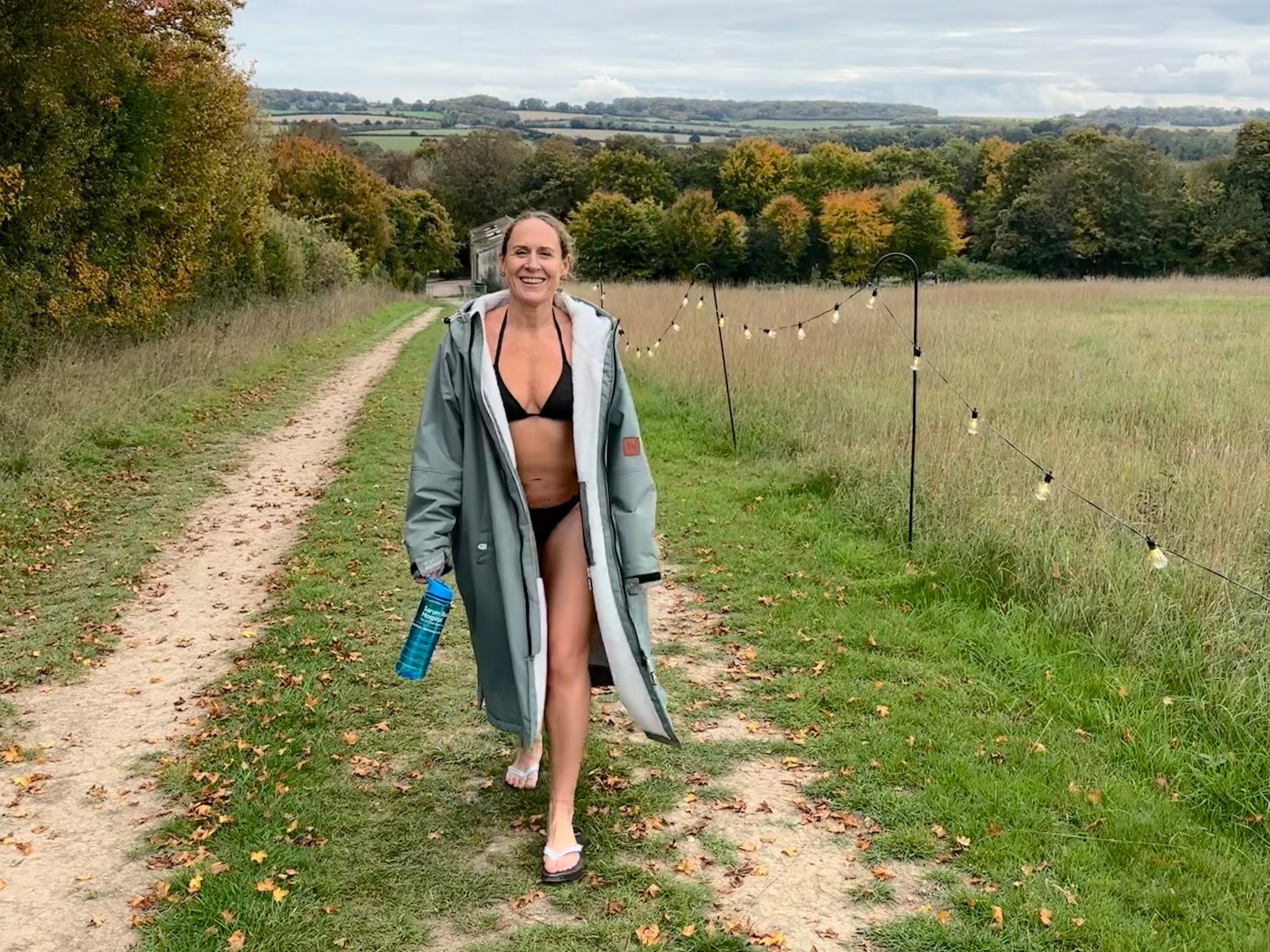
Again, I’m sold! It helps that I actually enjoy it too. And there are some really fantastic saunas popping up – by the sea, in woodlands, or overlooking lovely landscapes. I’ll share my favourites in a future blog! (Featured picture above is of me heading to one of these saunas just outside Winchester).
I was also delighted to note that women generally adapt better to heat therapy than extreme cold, so we don’t need to go as cold with cold exposure to get the physiological benefit, and coupling moderate cold with heat is thought to enhance overall stress adaptation.
Dr Patrick regularly talks on podcasts about the benefits of saunas. Here she is on her own FoundMyFitness podcast sharing 10 benefits.
So, there you have it, 5 things I’m doing differently now that I’m listening to the experts through the lens of being a perimenopausal woman!
Thanks for reading this far 🙂
Happy Friday! x
 Not The Mayo Clinic