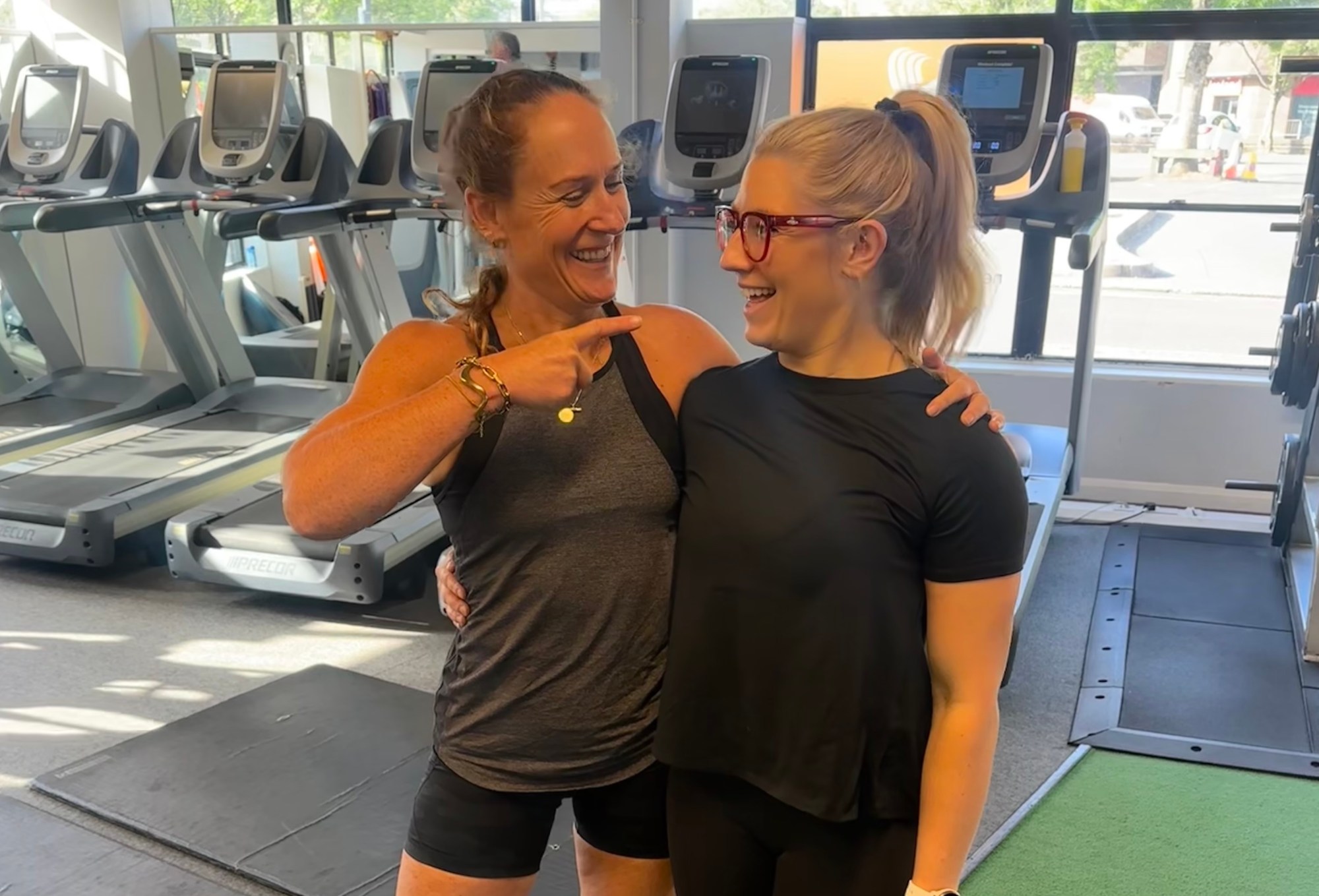
Welcome to the first of a new feature where on the last Friday of every month, I showcase a guest interview with a health and wellbeing expert answering five questions around a subject that matters to them (and me!)
And for the first edition of this new monthly feature, I’m delighted to welcome my Personal Trainer Lexi Uffindell… Lexi is here to talk about the power of movement. Especially through the lens of movement for women and someone who is my age – fast approaching 50! – and perimenopausal.
Lexi is a personal trainer based at New Energy Fitness in Winchester. You can read more about Lexi here.
I’ve been training with Lexi for a couple of years now since I moved to Winchester (she leads the Limitless series of group classes at New Energy Fitness) and on a 121 basis since the beginning of this year. My objective to her when we started my personal training was around longevity and vitality which is her passion and focus.
We’ve been working on my lifting technique and confidence, longevity tests (I mentioned a few last time), plyometrics and HIIT… Lexi is such an inspiring and technical trainer (for group and personal work) and my confidence and capability has improved ten-fold since I’ve been working with her. I thoroughly recommend Lexi to anyone looking for a personal trainer in the Winchester area!
So, let me give a massive Healthy High Five to Lexi:
Question 1: Why did you become a personal trainer Lexi? How long have you been doing it and what does movement mean to you?
In December 2018 over the Christmas break, I was at a crossroads thinking of where I would want to re-qualify and take my professional work. I was asked the question: “What do you love doing?’
And without hesitation I responded ‘Working with people and the gym!”
They smiled and said “Why don’t you retrain as a Personal Trainer?”
That afternoon I contacted a friend of a friend who was doing this as a career and got the ball rolling to find out more! I started my PT Qualification in January 2019 and I fully qualified at the end of that year. It’s now been over 6 years and I am so grateful I decided to pursue this avenue of work. I feel so lucky to be in a job I love and am so passionate about.
So, when you ask what movement means to me, it is so much more than trying to hit the prescribed ‘150 minutes of exercise a week’ or slogging away doing something you dislike because you ‘feel you should’. Movement for me is a gift. That you really get to enjoy the benefits and positivity not only in the moment (or maybe not in some challenging workouts) but when you are in your later years of life and are moving well and pain free. And movement can be anything; from walking or swimming, to weightlifting, dancing, or gymnastics and paddle. It’s finding what your love is.
Question 2: why should women (whatever their age) move their bodies?
Gosh, there are so many points I can talk about here as to why any woman of any age should move their bodies.
I would say a big one is that movement supports far more than just physical health and fitness. It can positively influence their confidence, energy, mental wellbeing, and quality of life throughout every stage as we age.
If we firstly think about strength training, it isn’t just about lifting weights in the gym. It’s knowing how this translates into our daily lives. When we are carrying in shopping, picking up our children / grandchildren (or Labradors in my case!) It could be climbing stairs, getting up from the floor, and remaining independent as we age. Some of my favourite feedback I have received from clients is when they share their wins with me about how their new strength and flexibility have unlocked something they never thought that they would be able to do in day-to-day life.
And for many women (my clients included), movement also creates valuable space away from work, caring responsibilities, and daily pressures. Sometimes this 1 hour a week with me is their only ‘me’ time, that allows them to step away from daily life and solely focus on them and their health.
Also, movement connects us. Social connection is such a powerful factor to both physical and mental wellbeing. And it’s been a gift seeing new friendships form though the classes I teach, and to see relationships and support blossom outside of the gym.
Question 3: What’s the greatest myth around movement that you want to bust and/or a truth that you want to shout from the rooftops?
Sleep is the foundation for optimal health. In an age of being constantly contactable, social media doom scrolling, busier lifestyle and demands on our time, one of the first things to fall down the priority ladder can be our sleep. I see it regularly with clients and my own friends that they wear their ‘I only got 5 hours of sleep last night’ as a badge of honour.
However, studies are now showing that for people on a weight loss plan or looking to optimise their performance / lean muscle mass, sleep deprivation significantly reduces the amount of fat you lose during a calorie deficit and building of lean muscle mass when on a building phase.
For those who are in a calorie deficit and regularly getting minimal sleep may still see their scales dropping, however insufficient sleep alters your body composition, causing you to lose 55% less from fat and 60% more muscle mass. I cannot stress how important maintaining lean muscle mass is for all ages of people, but especially for women going through perimenopause.
I know sometimes poor sleep hygiene and duration can’t be helped (my hats off to any parent and shift worker). Here are a few pointers I hope can help any of your readers struggling with this currently:
1. Protein Becomes Even More Important
Aim for:
- 1.6-2.2 g/kg/day protein
- 25-40 g protein per meal
- 3 to 5 protein feedings per day
When recovery is compromised, adequate protein helps offset some of the anabolic resistance associated with sleep loss.
2. Reduce Volume Before Reducing Intensity
If sleep is poor, instead of:
- 4 to 5 workouts a week of 20+ sets per muscle
Maybe try:
- 2 or 3 full-body sessions a week. Keep the loads relatively heavy but reduce volume.
Maintaining strength is one of the strongest signals for maintaining muscle mass.
3. Prioritise Consistency Over Perfection
The goal during periods of disrupted sleep is often maintenance, not optimisation.
Many sleep deprived individuals can maintain most of their muscle mass with surprisingly little training provided they:
- Keep lifting
- Eat enough protein
- Avoid large calorie deficits
Something that is echoed frequently by experienced lifters and coaches who have discussed training through early parenthood.
Caveat – If you’ve had a poor night’s sleep, taking a high single dose of creatine (15-20g) may help reduce some of the negative effects that poor sleep can have on your energy levels, focus, and mental sharpness. Creatine is one of the most research supplement and recent studies have found that it doesn’t only benefit the gym / strength but also cognitive health.
Question 4: what’s the best mix of exercise for a perimenopausal woman like me to be doing and why?
When it comes to working with Peri-Menopausal clients, I take a lot of my advice from leading professionals in women’s health, like that of Stacy Sims.
Lift Heavy – By doing this we aim to maintain our valuable muscle, bone density, metabolism; your body’s engine. It takes in fuel (food) and converts it into the energy and building blocks needed to keep everything running, and our physical strength.
Move Fast – We want to continue to train our power. Power is the ability to produce force quickly, and in simple terms, it’s how fast you can use your strength.
“Strength is your foundation. Power is your insurance policy.”
Building and maintaining both gives women the best chance of staying strong, capable, and resilient throughout midlife and beyond.
Sprint Occasionally – We can try to use short, intense intervals rather than excessive cardio. The goal isn’t to spend hours doing cardio. It’s to strategically include short bursts of high-intensity effort that help offset some of the physiological changes that come with ageing and menopause.
Eat Enough Protein – As oestrogen levels decline, women can become less efficient at building and maintaining muscle. This means protein becomes even more important for preserving strength, supporting recovery, and maintaining overall health.
Recover Well – Training is only part of the equation. Exercise provides the stimulus for change, but recovery is where the adaptation happens.
You don’t get stronger during a workout; you get stronger when your body repairs and adapts afterwards.
This becomes even more important during perimenopause and menopause, when hormonal changes can affect sleep quality, recovery capacity, energy levels, and resilience to stress.
For more information read this article by Dr Stacy Sims.
Question 5: Anything that you’d like to add Lexi around the subject of movement – an interesting fact or podcast you’d recommend or anything else to encourage someone reading this blog today to go out there and move their body?
I LOVE a podcast, and to be honest I have many a sports podcasts on the go. One that I would recommend to someone getting into the fitness space is: Fitness Stuff (for normal people)
And for anyone who wants to get a little Geeky with the latest research and scientific findings in the fitness world I would recommend: Flex Diet Podcast
It’s been such a joy and privilege to be a part of your blog and sharing my thoughts and love of movement with your readers. I hope they can take something from what I have had to share and I will leave you with this final thought:
Movement is a way of investing in ourselves. It’s a way to build a stronger body, a healthier mind, and a more resilient future. At every age and every stage of life, movement helps women do more of the things they love, for longer!
Wow, thank you so much Lexi for sharing your passion with me on Not The Mayo Clinic. I’m going to go listen to those great podcast recommends now, for sure! And thank you for the inspiration you bring me daily at the gym… I hope that you (yes you dear reader!) found Lexi inspiring too, and hope you have discovered the movement that brings you joy…
I also want to thank New Energy Fitness for the community that it brings together – I love my 7am classes with Lexi and with Alys too – they’re both excellent trainers. I have also been so fortunate to meet a lovely bunch of people by attending the Limitless classes, with one shout out in particular to Lucinda who has become a great friend and I love training with her 🙂
Thank you again Lexi! You can follow Lexi on Instagram here.

