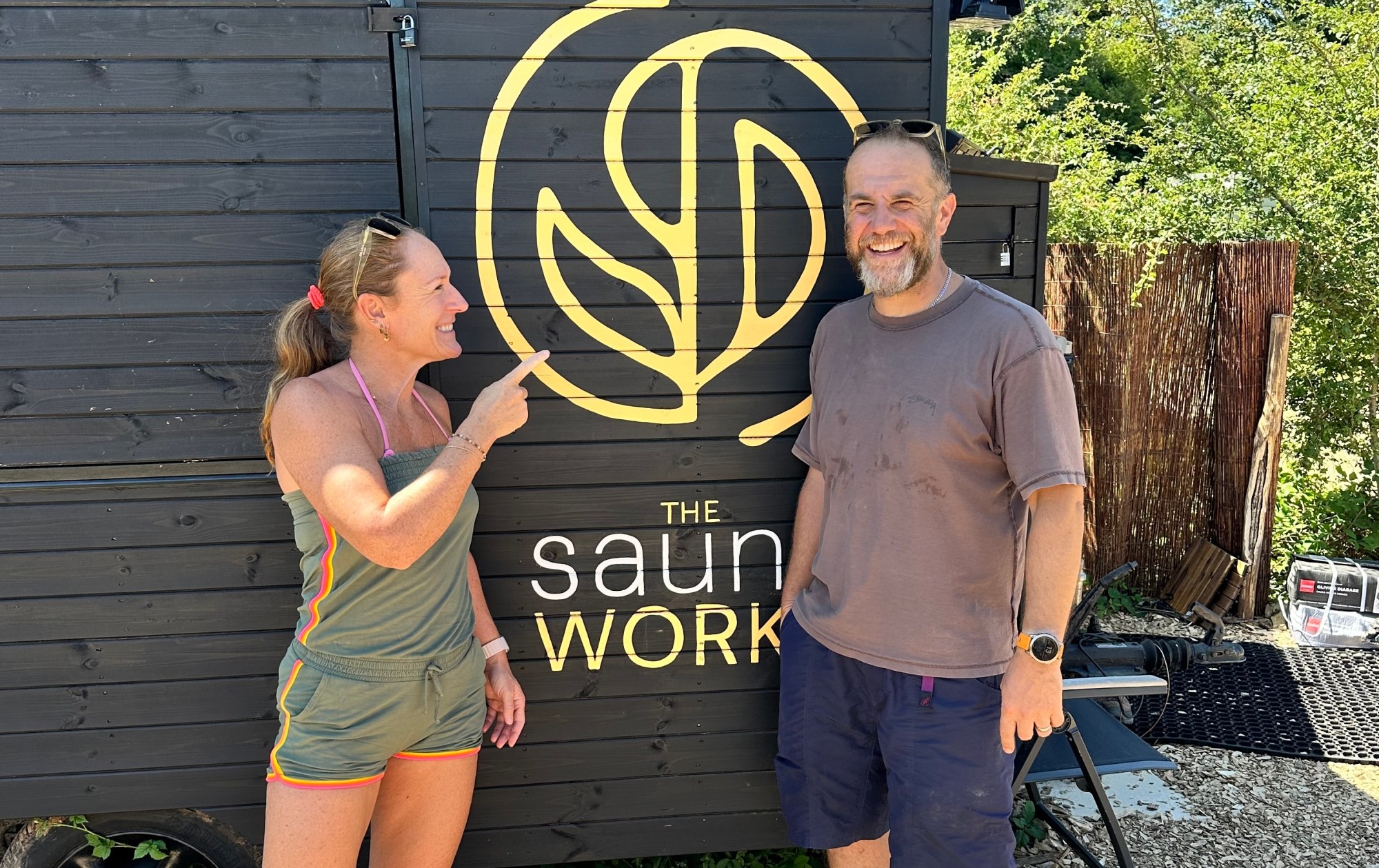
Welcome to the next in my new series of Healthy High Fives – where on the last Friday of every month, I showcase a guest interview with a health and wellbeing expert answering five questions around a subject that matters to them (and me!)
And for this next edition, I’m delighted to welcome Eddie, the founder of The Sauna Works… I wrote about The Sauna Works in my Love Letter to the Sauna back in February this year.
Eddie set up The Sauna Works at the end of 2025. You can find out more about Eddie, Sauna Works and how to book a sauna here.
So, let’s get into it… Let me give a massive Healthy High Five to Eddie:
Q1: Why did you decide to set up The Sauna Works and what’s your philosophy?
It started as a way of dealing with my own stress. Back in 2022 I fell in love with sauna while I was in a full-on tech job. It was a way to offset the burnout and anxiety I was feeling. When redundancy came along, I took it as a sign to change what I was doing and move into something that gives me a real sense of purpose — after years stuck behind a desk, I wanted to work outdoors, among nature, helping people boost their health and ease their stress through sauna. I trained with the brilliant Deborah Carr at Anada and ingenious free spirit Jesse Devlin at Sauna Corner in a variety of Sauna Master Certificates in Sauna Rituals, Aufguss, and Herbs and Whisks, I then was put in touch with the wonderful Jon and Holly Wright, who run Jolly Moon — a nature-based wellbeing and education project and forest garden where they live on-site with their young daughter — who agreed to let me rent a corner of their land to set my mobile sauna up. I cleared the site with the help of friends and family, got a shower and plunge pool in place in alongside the sauna, and The Sauna Works launched in November 2025.
We’ve grown almost entirely by word of mouth since then, which still amazes me. Despite what’s honestly still a pretty basic online presence, people are telling their friends, and the bookings are growing week on week. The Hampshire Chronicle has kindly covered the sauna, describing The Sauna Works as somewhere “people are finding happiness” which really made me believe what I am doing is starting to make a difference to peoples lives and very much part of the reason I started this journey.
Coming from what was sometimes a toxic work environment, I honestly don’t think I’ve met a single person through sauna that I didn’t like — the community that is forming around the sauna is brilliant. There’s a fire pit just outside the sauna, next to the plunge pool and shower, where people gather to keep talking, still wrapped in towels, not quite ready to leave. Some of my favourite moments happen right there – people swapping numbers, new friendships being made and reconnection happening right in front of my eyes. I think it’s also why the sessions have grown so organically since we opened — sound baths, whisking rituals, silent saunas, men’s sessions, Monday afternoon slots — every one of them came from people asking for it, not from some grand marketing plan.
What struck me from the very first sessions, taking the mobile sauna around Winchester, Basingstoke and Andover before settling at Jolly Moon, was less about the heat and more about what happened in the room: strangers chatting, phones left in bags, people actually looking at each other – real life interaction! In a world where we’re all glued to screens, there’s something quietly radical about a wooden box that forces you to just be somewhere with other humans.
That’s really the philosophy — sauna and cold plunge as tools for community and connection. For me it’s always been about more than relaxation; it’s about supporting mental and physical wellness, creating space for real conversation, and building an actual sense of community.
We’re an Operator Member of the British Sauna Society, which matters to me because it shows we are serious about what we do and want to maintain the highest standards. I wanted us to do this with real expertise and respect for the tradition of sauna, not as a just a gimmicky wellness trend. Warm, unpretentious, rooted in tradition, and backed by science — that’s the whole ethos, and it’s exactly what “Relax, Recharge, Reconnect” means to us.
There’s a stress-management side to this too, which doesn’t get talked about enough. The heat and cold are doing genuine physiological work on your nervous system — helping regulate cortisol and giving your body a proper “off switch” after a day that’s kept you switched on. But just as much of the benefit, I’d argue, comes from what happens between people in that room. The U.S. Surgeon General declared loneliness and social isolation a public health epidemic back in 2023, describing the health impact of chronic disconnection as comparable to smoking up to 15 cigarettes a day. That’s the world we’re quietly pushing back against — somewhere people put their phone down, sit shoulder to shoulder with neighbours and total strangers, and actually talk. A proper “third place,” neither home nor work, where community tends to happen almost by accident rather than by appointment.
The British Sauna Society, has been collaborating with Dr Martha Newson at the University of Greenwich on research into exactly this, surveying UK sauna-goers. Their findings, published in 2026, showed that the wellbeing boost from sauna isn’t just about the heat — a good deal of it is explained by the sense of belonging and social connectedness that builds through shared ritual, with people who sauna weekly reporting notably better outcomes than those going monthly.
We’ve started building on that directly, through something we call Beyond The Sauna – Community Walks, run in partnership with Emma McCaffery, a Winchester personal trainer and founder of Move with Emma, who’s been part of The Sauna Works from day one. The idea is deliberately unstructured — an evening of walking and talking, with an optional river dip for anyone keen, and nothing else on the agenda. No fitness goals, no networking, nothing to perform. Emma put it beautifully afterwards: it felt like something people have been missing without quite knowing how to name it. That, for me, sums up the whole project. The sauna gets people through the door, but it’s what forms around it — the conversations, the walks, the strangers who stop being strangers — that keeps them coming back.
Q2: If you were talking to someone who has never set foot in a sauna, how would you describe the benefits?
I’d start with how it actually feels — to me that’s the most important thing – we can easily over analyse and overthink wellness activities and I feel sauna is something that needs to become a part of your life that is easy and makes you feel great. All the benefits are fantastic, but we shouldn’t underestimate just how good it makes us feel. The initial wave of heat, the magical steam (loyly), stepping out into nature for cooling relief and the release of endorphins that just make you feel amazing. To me it’s addictive in the best possible way.
There’s plenty to back up the feeling. Dr Jari Laukkanen has run some of the biggest long-term studies on this — one following over 2,000 men for two decades found that using the sauna 4–7 times a week was linked to a 40% lower risk of dying from any cause compared with once a week, and significantly lower cardiovascular risk too. The thinking is that regular heat exposure trains your heart and blood vessels much like moderate exercise does.
Then there’s Dr Rhonda Patrick over at Found My Fitness, who’s done a lot to popularise the cellular side of things — heat exposure switches on “heat shock proteins” that help repair and protect your cells, and can boost growth hormone, which matters for recovery and healthy ageing. Add better sleep, lower stress, and a proper endorphin lift, and you’ve got a habit that’s doing far more than just making you feel nice for an hour.
There’s also a growing body of clinical research specifically on the mental health and stress side. Dr Ashley Mason at UCSF has been running trials combining whole-body heat therapy with cognitive behavioural therapy for people with depression, with genuinely promising early results on mood and on the inflammatory markers often raised in depression. Her team has also pointed out that sauna culture typically comes with a built-in social element — people tend to do it together, in a room, facing each other — and that this social piece may be doing just as much therapeutic work as the heat itself. So it’s never really just about the temperature. It’s the nervous system reset and the sense of actually being with other people, at the same time.
On the stress side specifically, what’s happening physiologically is your body learning to move between “on” and “off” more efficiently. Heat pushes your sympathetic nervous system up, cold gives it a sharp reset, and doing that on repeat is a bit like interval training for your stress response — your system gets better and quicker at calming back down afterwards, which is the same skill that helps with everyday stress, not just the stress of temperature. It’s what we call our “inner fire” here — it’s not that stress disappears, it’s that your nervous system gets more practised at recovering from it, and comes out more resilient each time.
And on the connection side, researchers at Oxford, including Robin Dunbar, have found that when people go through a shared physical challenge together — a bit of discomfort and doing something hard as a group — it triggers an endorphin response that measurably increases feelings of closeness between people, even strangers.
Q3: How do the benefits of saunas and cold-water therapy differ for women and men, especially through the lens of perimenopausal women?
This is a really interesting question and one I’ve been looking in to as a result. I’ve learned a huge amount about this from Dr Stacy Sims, an exercise physiologist who’s spent her career on female-specific physiology. Her core point is that women aren’t just “smaller men” — women regulate heat and cold differently, our cardiovascular and hormonal responses to stress differ, and that means the advice shouldn’t be identical for everyone.
For perimenopausal women specifically, Sims talks about sauna use helping with some of the trickiest symptoms of that life stage — supporting sleep, aiding recovery, and even helping the body’s thermoregulation cope better with hot flushes, alongside recovery and mood benefits from the heat shock protein response. Cold water immersion gives a lot of benefit too, for the mood and energy lift, though she’d encourage women to be a bit more thoughtful about timing around training and hormonal fluctuations than the average “just jump in” advice suggests.
It’s also worth saying the big Laukkanen sauna studies weren’t just done on men — a major 2018 cohort study specifically confirmed the cardiovascular mortality benefits held for women too. So the core science appears to be for everyone; but the fine-tuning around women’s physiology is really important, especially through perimenopause, where the nuance lives.
There’s a British study on exactly this too. Researchers at UCL, led by Professor Joyce Harper, surveyed over 1,100 women in the UK who swim regularly in cold water, including 785 who were going through perimenopause. Nearly half reported a meaningful improvement in anxiety, alongside real reductions in mood swings, low mood and hot flushes. It’s a self-selected survey rather than a controlled trial, so it can’t prove cause and effect on its own, but it aligns with what Sims and Søberg describe physiologically.
Dr Susanna Søberg — the researcher behind the Søberg Principle — has spoken about her own landmark cold-and-heat research starting as proof-of-concept in men first, simply because that’s how physiology research has traditionally been designed. Though now she has run a trial including women and she’s since been writing in detail about what’s actually different for women: a different distribution of body fat, a different surface-area-to-mass ratio, and a cold and heat response that shifts with oestrogen and progesterone — meaning the “right” dose isn’t just different for a woman versus a man, it can shift across a single woman’s own cycle too.
On the sauna side, her recent work points to the nervous-system benefits — helping regulate cortisol, sleep and mood — as arguably the biggest win for women navigating perimenopause and menopause, when all three of those can be thrown off balance.
Q4: What’s the greatest myth you want to bust, or a truth you want to shout from the sauna rooftop?
There are a few I could pick, so let me run through my top three.
Myth: “sweating out toxins.” – while your skin does release trace amounts of things like heavy metals, your liver and kidneys are doing the real heavy lifting which the sauna is helping to support.
Myth: colder and longer is always better. — the coldest water for the longest time worn as a badge of honour is just such a bad idea. Dr Susanna Søberg has been pushing back on this, making the point that the goal isn’t extreme cold, it’s a stress your nervous system can actually recover from. Push it too far and you’re not training your body, you’re just taxing it.
Myth: once you’re used to cold water, the risk basically disappears. This one matters to me because we take safety seriously here. Professor Mike Tipton at the University of Portsmouth, one of the world’s leading researchers on cold water immersion, has spent decades showing that the initial “cold shock” response — the gasp, the rapid breathing, the strain on your heart — is a genuine physiological event every single time, however experienced you are. It’s why we keep our sessions short, supervised and sensible, rather than leaning into the “no pain, no gain” bravado you sometimes see online.
And here’s my truth: sauna is a cardiovascular workout for people who’d rather sit still. The heat pushes your heart rate up into moderate-exercise territory, trains your blood vessels, and triggers cellular repair mechanisms — genuinely comparable, physiologically, to a brisk walk or gentle jog. And crucially, you don’t need heroic amounts of it. Søberg’s research suggests as little as an hour of heat and 11 minutes of cold spread across a week is enough to see meaningful benefits. Little and often beats occasional and extreme.
Q5: Anything else you’d like to add to encourage someone to embrace sauna culture today?
The British Sauna Society’s UK Sauna Map has grown from around 45 saunas when they started counting in January 2023 to well over 600 public saunas today, with wild saunas alone more than doubling in the last year – which is just amazing and shows to me how much people are loving sauna and how sauna culture in Britain is really getting embedded into our everyday lives. It’s a real joy to be part of.
One of my favourite things has been working in collaboration with other wellness / fitness practitioners, to create and even more elevated experience. Whether that be a sound bath, group fitness session, or a recovery session with all different types of athlete.
We recently ran a sound bath collaboration at Jolly Moon with Philip Campling, a Hampshire-based sound therapist who uses gongs and Himalayan and crystal singing bowls to help people properly unwind before they even reach the heat. Kimberly Barber a Hampshire Chronicle journalist described lying wrapped in blankets while birdsong, a distant woodpecker and even a lazy bee wove themselves into the soundscape “quite simply, bliss.” Moving from there into the sauna, the cold plunge, and my leaf whisking, before finishing around the fire pit with hot drinks and brownies. What struck her most, was the quiet camaraderie among a group who’d started the morning as total strangers — and she left having had precisely the reset she hadn’t realised she badly needed.
For listening, I’d point people toward Dr Susanna Søberg’s conversation on the ZOE podcast — it’s a lovely, down-to-earth explanation of the “Søberg Principle” and why you really don’t need to suffer for hours to get the benefits. The Huberman Lab episode with Dr Stacy Sims is another great one if you want the female-specific angle. And for something homegrown, Emma O’Kelly’s book Wild Sauna is a beautiful tour of Britain’s outdoor sauna scene if you fancy some local inspiration.
My biggest encouragement is simpler than any study: come and try it. Sit in the heat, feel your shoulders drop, take the plunge, gasp, laugh with the stranger next to you doing the same thing — and see how you feel afterwards. In a world that’s genuinely struggling with stress and disconnection, that hour of switching off together might be one of the simplest, most evidence-backed things you can do for yourself all week. The science is wonderful backup, but the feeling — and the company — is what keeps people coming back. Whether you’re brand new to sauna or already love the ritual, there’s always a warm welcome waiting, and I can’t wait to share some löyly with you.
And if sauna itself feels like a big first step, we also run Community Walks with Emma McCaffery of Move with Emma — simple evenings of walking and talking in and around Winchester, sometimes with an optional river dip for anyone keen, and genuinely no agenda beyond turning up. They’ve turned into a lovely, low-pressure way to meet the community before you ever set foot in the sauna. Keep an eye on thesaunaworks.com or movewithemma.co.uk, or drop me a line at ed@thesaunaworks.com, if you fancy joining the next one.
//
Wow, thanks so much Ed! Such an interesting read and loads of useful references to follow up with too. I can truly attest to the wonderful community that you are growing at Sauna Works… we always enjoy chatting to everyone we meet there. As I always say, there’s no small talking in a sauna! You really get into some really meaningful conversations quite quickly. So… if you have yet to try it, come to Winchester and visit Sauna Works for yourself to find out why and I’m pretty sure you’ll be as hooked as I am!
Thank you again Ed. You can follow Ed and The Sauna Works on Instagram here.

